
Full case study
Agentic AI for lighting specification and tender evaluation
- Client
- A lighting consulting company
- Sector
- Lighting Design
- Engagement
- AI Solutions
An AI agent reads manufacturer datasheets and supplier proposals, links every value to its source and proposes verdicts. A qualified engineer confirms each one before it reaches a client.

Hundreds
Luminaires in a single project
Thousands
Fixture values extracted into the SpecBook
Every verdict
Confirmed by a qualified designer
01
Executive Snapshot
A lighting consulting company uses human-supervised AI to get the work done while qualified engineers retain final authority.
- 01Use case: lighting specification and tender evaluation
- 02Sector: lighting design consultancy
- 03Core challenge: high-volume document reading and expert judgement
- 04Solution: governed, evidence-linked AI preparation with human confirmation
02
The Business Challenge
Every project can involve hundreds of luminaires. Each manufacturer datasheet uses its own layout, units and vocabulary, yet every fixture must become a consistent SpecBook entry with many fields.
At tender, supplier PDFs must then be checked field by field against that specification, often across several options and resubmissions. Manual retyping slows preparation and creates avoidable opportunities for error. Verification requires reviewers to search inconsistent PDFs, while compliance tolerances and equivalences can remain implied in individual engineers’ heads.
Spreadsheet-based review also provides limited traceability, and the teams may struggle to see where a value originated, why a verdict was proposed, or how an offer changed between rounds.
The challenge was therefore not simply extraction. It was scaling disciplined reading and judgement without weakening professional accountability.
03
The Solution
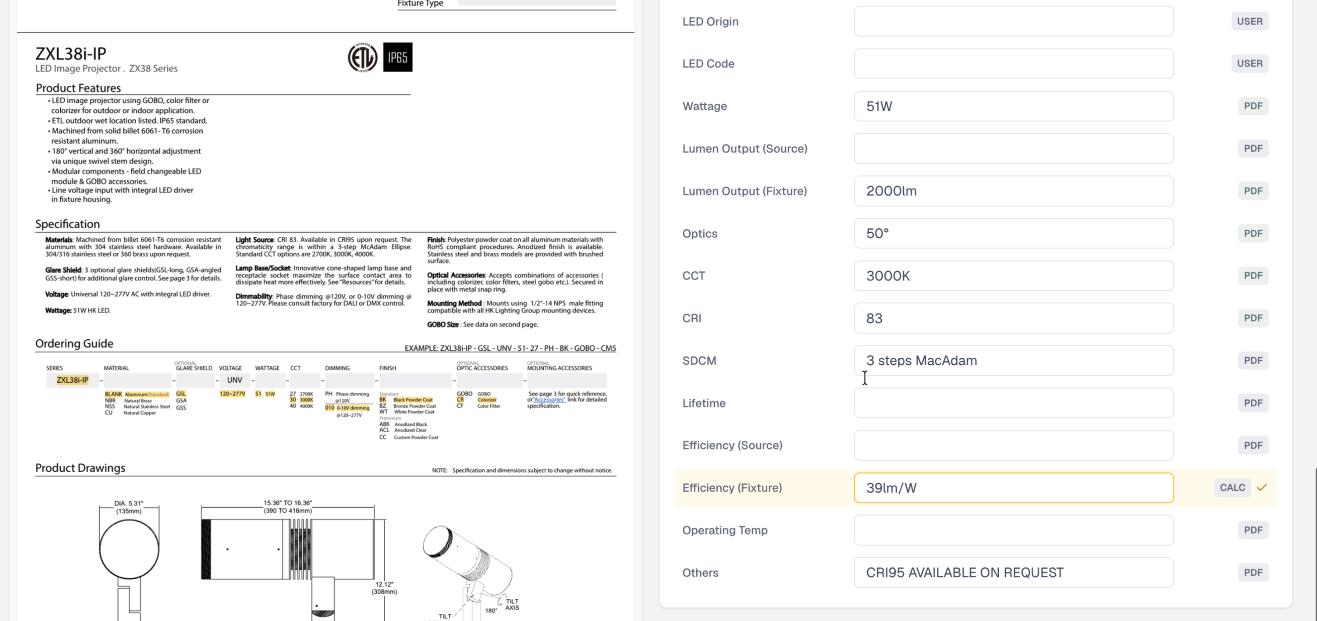
The consultancy established a single governed operating model for specification and tender work. The AI agent reads manufacturer datasheets and supplier proposals into the same solution, using maintained field definitions and extraction guidance. For each value, the workflow records the source page and region so an engineer can move directly to the supporting evidence. Extracted values are labelled for review, and missing information remains visibly marked to the user for validation.
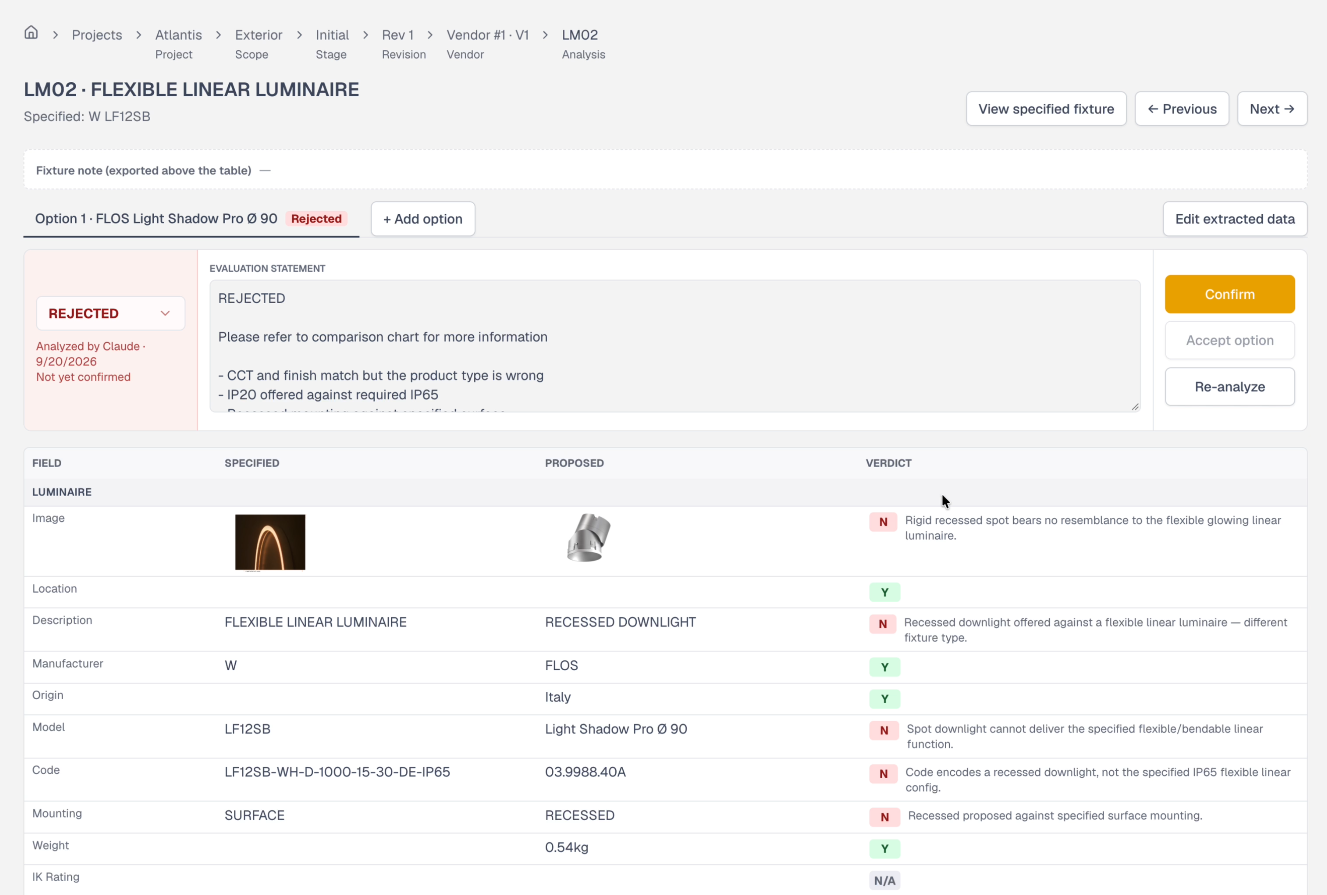
The same structured data then supports tender assessment. The system is configurable for the level of guidance, accepted tolerances, equivalences and deviations. The AI agent applies those written rules to propose field-level verdicts and concise justifications, then an overall option assessment.
It does not certify compliance on its own: a qualified designer reviews, can override, and must confirm the analysis before anything reaches a client deliverable.
Suppliers can resubmit in versions, preserving the earlier offer and reasoning. Structured outputs make values and verdicts comparable and storable, while human corrections can be updated in the solution for future extraction guidance. This combines preparation speed with controls that keep accountability where it belongs.
04
Business Value
Less manual retyping
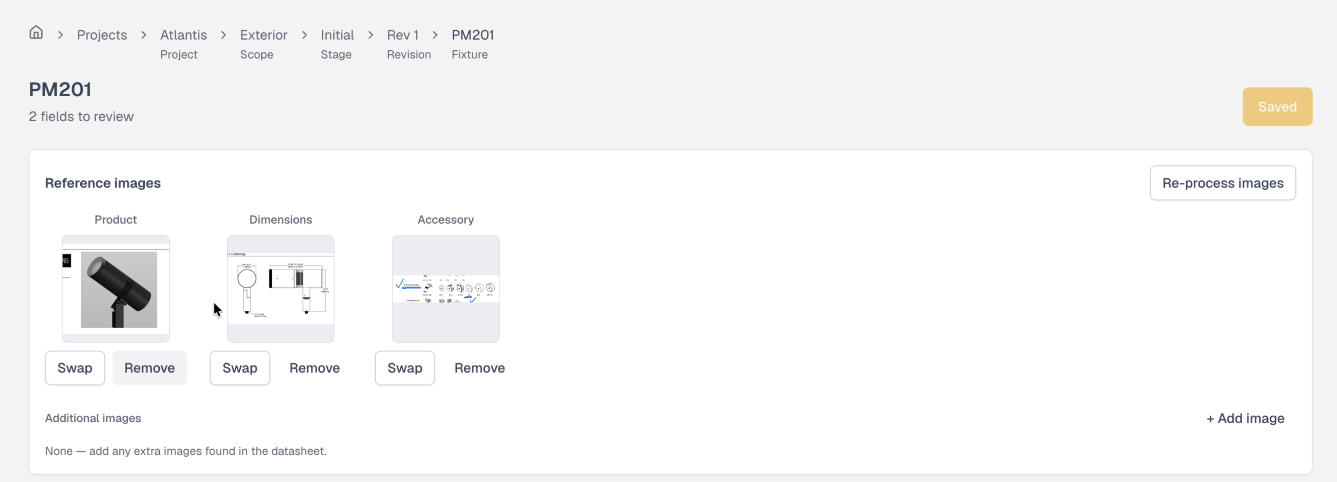
Thousands of structured fixture data are extracted into the SpecBook format, allowing engineers to focus on review rather than repeatedly transferring values from PDFs.

Faster, more focused verification
Reviewers can directly reach the source location, while the system marks and labels any missing information for attention.
Consistent and adaptable rules
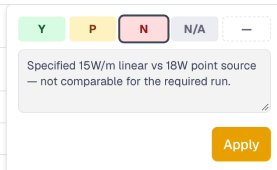
Written rules for extraction and evaluation guidance give every proposed verdict the same reference point, with a concise reason that a professional can inspect and change.
Preserved audit and history
Recorded confirmation and versioned resubmissions retain who approved an analysis, when it was confirmed, what was offered and how the judgement evolved.

Expert judgment that can be reused
Field definitions, judging rules and maintained extraction guidance turn recurring know-how into an organizational asset, leaving engineers more time for exceptions and professional judgement.

05
Strategic Relevance
This workflow converts individual expertise into governed, reusable institutional knowledge without transferring decision authority to the AI alone. The consultancy can apply the same evidence structure and written rules across projects, suppliers and resubmissions, while qualified professionals remain responsible for confirmation and client outputs. The result is a scalable way to prepare and review document-heavy work with clearer traceability, uncertainty and control.
Part of
Cognit AI Solutions
AI agents and solutions built around specific workflows, on Cortex or the architecture that fits.

Next case study · AI Academy
The course behind One Million Prompters
Read it